2024 Summer Research Religion Cohort: Four Students Share their Experiences
Pluriverse
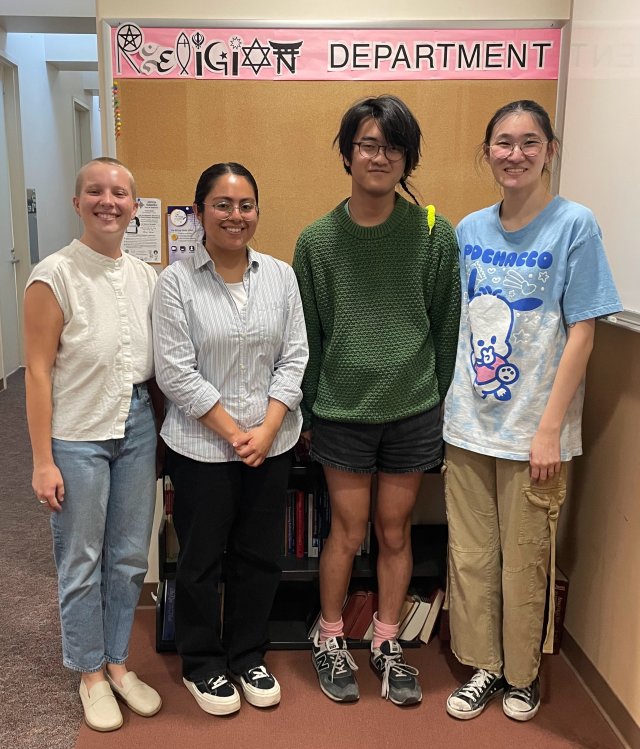
2024 Religion Summer Research Cohort (from left to right): Alexia Lye ‘25, Daniela Munoz-Martinez ‘25, Ken Flores ‘26, and Jackie Shaw ‘25.
By Jacqueline Shaw
The word “research” often evokes images of test tubes, beakers, and brightly-colored liquids in a sterile lab, but research in the humanities can look very different. It can be anything from reading a book (or ten), participating in religious ceremonies, to conducting interviews. This summer, four students, Jackie Shaw ‘25, Alexia Lye ‘25, Daniela Munoz-Martinez ‘25, and Ken Flores ‘26 participated in Cal Lutheran’s 8-week Undergraduate Research Program. Each student received a summer research grant: Ken and Jackie received The Louis W. and Gladyce Foster Family Foundation Summer Fellowship in Research; Alexia received the Summer Undergraduate Research Fellowship (SURF); and Daniela received the ASCENSO Hispanic Fellowship. The students met weekly alongside their faculty mentors from the Religion Department to discuss challenges and celebrate their successes throughout the research process.
Jackie, under the mentorship of Dr. Julia Fogg, studied medieval Benedictine abbess Hildegard von Bingen and her theology of liturgy, specifically of voice and singing. “I chose this topic because singing has been how I most deeply connect to the divine, but the evangelical traditions I grew up in have devalued it as a practice of faith,” says Jackie.
Originally, Jackie began with a more general study of the role of singing in worship, but focused on Hildegard’s work as it answered many of the theological questions she had. “This research is a reminder that there are many different spiritual gifts and none make the individual more or less pious,” concludes Jackie. “What’s important is the intention to wholeheartedly praise God.”
Alexia, under the co-mentorship of Dr. Sam Thomas and Dr. Khrystyne WIlson, studied the importance of abalone to the Chumash people, as well as the potential for the expansion of repatriation to include elements of the natural world: “Native access to these particulars of place is essential for disrupting cycles of historic violence,” says Alexia.
Alexia is pursuing a career in the museum industry and while museums are essential knowledge seekers, keepers, and educators, they are also often complicit in perpetuating harm against systemically vulnerable communities such as Indigenous peoples. “It is my personal vocation,” Alexia elaborates, “to help catalyze repair between these communities and institutions to promote cultural protection, revitalization, and sovereignty.” She aims to bring Native voices to the forefront of these discussions in academic spaces.
Alexia will be continuing her research this academic year and potentially into graduate school. Her next step is to conduct interviews with Tribal members. “I am deeply honored that my project will be directly guided by native insights and knowledge,” she says. “I hope to then bring their voices to conferences, presentations, and any willing audiences to create tangible change in these industries.”
Under the mentorship of Dr. Jennifer Hahn, Daniela studied the utilization of differing biblical interpretations in pro- and anti-slavery arguments leading up to the Civil War. When asked how she came upon this topic, Daniela states: “I began my work in Dr. Hahn’s class ‘The American Religious Experience’ for a research assignment. During this time I was re-evaluating perspectives and interpretations of the Bible I grew up with.” Her research also led her to the contributions of Black liberation theologians and how the African American experience has influenced biblical interpretation. Daniela plans to present her work at conferences, but is most excited about sharing her research with her church community: “I want to challenge them to see beyond their preconceived religious notions and see the value in addressing religious topics from different points of view.”
Ken, also under the mentorship of Dr. Julia Fogg, studied Shinto and its presence in the U.S., focusing on the Shinto Shrine of Shusse Inari in America and its online community. “I decided to focus on Shinto because it’s my home faith and I’m fascinated by the practice of a Japanese religion in non-Japanese contexts,” says Ken. While their research began with looking at community-building strategies, it eventually evolved into an exploration of legitimacy and authority in the practice of religion. “The sources I read and the conversations I had with the community led me in this direction,” Ken explains. “A lot of the time your research takes you to places you never imagined, and you have to be okay with that,” Ken says.
Ken plans to present their current work at conferences, and continue doing research during the upcoming summer and into their senior year.
All four researchers strongly encourage any interested undergraduate students to take advantage of this opportunity to gain experience in their respective fields and the research process. For those nervous about doing research, Daniela states: “I encourage you to see it as a learning experience, and that research is not only for one type of student.” Alexia also elaborates on the value of the summer research experience: “This is a unique opportunity to access resources and communities who will support you in navigating these inquiries, that you may never otherwise be presented with.”
Jackie, Alexia, Daniela, and Ken all presented their research on October 19, 2024, at CLU’s annual Student Research Symposium.
The Religion Department would like to thank the Foster Family Foundation for funding two research fellowships in our department: one for Religion majors/minors and one for Theology & Christian Leadership majors/minors.
More
- 2024 Summer Research Cohort Takes On Conferencing!
May 5, 2025All four members of the Religion Department’s Summer Research cohort (Alexia Lye ’25, Daniela Munoz-Martinez ’25, Ken Flores ’26, and Jacqueline Shaw ’25) had their research accepted for the Western Region’s (AAR-WR) annual conference. Alexia’s research discusses Abalone and its importance to the Chumash people. Daniela’s research explores how the Bible was used for and against slavery. Ken’s work explores the rituals of the Shinto Shrine of Shusse Inari in America. Jacqueline’s research examines different interpretations of jihad in medieval Islam.
- Why Study Religion or Theology? And Other Questions About Our Department
November 15, 2024Students often have the same two questions about the Religion Department. “Does the department only teach Christianity?” and “Will professors try to convert me?” The answer to both questions is an emphatic, “No!” The Religion Department—and the CLU as a whole—is committed to the values of Lutheran higher education, emphasizing open-mindedness and inclusion of those from all faith traditions and worldviews.
- 2024 Summer Research Religion Cohort: Four Students Share their Experiences
September 24, 2024The word “research” often evokes images of test tubes, beakers, and brightly-colored liquids in a sterile lab, but research in the humanities can look very different. It can be anything from reading a book (or ten), participating in religious ceremonies, to conducting interviews. This summer, four students, Jackie Shaw ‘25, Alexia Lye ‘25, Daniela Munoz-Martinez ‘25, and Ken Flores ‘26 participated in Cal Lutheran’s 8-week Undergraduate Research Program. Each student received a summer research grant.
- Religion: The Queer Experience
May 3, 2024On March 19 in the Samuelson Chapel Lounge, the Religion Department hosted an event for queer folx at Cal Lutheran to discuss their experiences with religion.
- Longtime Religion Professor, Rev. Dr. Colleen Windham-Hughes, Installed as Associate Vice President of the Office of Mission and Identity
April 26, 2024The Religion Department would like to congratulate Rev. Dr. Colleen Windham-Hughes on her installation as Associate Vice President for the Office of Mission and Identity as of February 22, 2024!
- Religion Department: New Course Offerings for 2024-2025 Academic Year and Beyond
March 31, 2024The Religion Department is excited to announce new courses for the 2024-2025 academic year! These courses fulfill the Humanities requirement of the new general education IDEAS curriculum.
- Nurturing Communities Through Research: Three Religion Students Share Their Passion Projects
December 15, 2023In the world of academia, religion often yields profound insights into the past, present, and future of our societies. It is within this dynamic context that three dedicated religion students, armed with a passion for their respective research interests, embarked on a journey to shed light on fundamental issues in our communities.
- Event Recap: Decolonizing Music: Zitkála-Šá’s Sundance Opera and Religious Resistance
December 5, 2023On November 14 in Overton Hall, the Religion Department in collaboration with the Ethnic and Race Studies Program, hosted a special guest lecture on an Indigenous opera of resistance as part of CLU's program in honor of Indigenous Peoples' Heritage Month.
- Religion Department Welcomes Assistant Professor With Expertise in Indigenous Traditions and Law
November 15, 2023“I'm thrilled to join the faculty at CLU,” Dr. Wilson says. “During my visit last spring, I was impressed by the caliber of students and the university's commitment to service. I'm excited to bring my expertise in Indigenous religions and religious freedom to the department and I look forward to serving as a bridge between CLU and Indigenous communities.”
- Love Knows No Borders: Theology & Christian Leadership Major Speaks at Women of the ELCA Triennial Convention
October 6, 2023