Why Study Religion or Theology? And Other Questions About Our Department
Pluriverse
By Ken Flores
Students often have the same two questions about the Religion Department. “Does the department only teach Christianity?” and “Will professors try to convert me?” The answer to both questions is an emphatic, “No!” It is, of course, understandable that students would be worried about this. CLU is, after all, a religiously affiliated institution.
However, the Religion Department—and the university as a whole—is committed to the values of Lutheran higher education, emphasizing open-mindedness and inclusion of those from all faith traditions and worldviews. To help students discover their passions and reach their full potential, the department offers two programs, both available as majors and minors: Religion and Theology and Christian Leadership. Under the Theology and Christian Leadership major/minor, are three emphasis areas: Arts and Spirituality, Not-for-Profit and Social Sector, and Youth and Family Ministry.
The fields of religious and theological studies, like many other areas in the humanities, are interdisciplinary. The professors of the Religion Department have a wide range of expertise in different faith traditions and aspects of religion, including Indigenous religions, early Christian scripture, religious ecological thought, popular cultural depictions of religion, ethics, and the intersection of law and religion. Both the religion and theology programs have a great deal of flexibility to allow students to take courses that align with their other programs and interest areas.
Still, it is understandable that students would have some trepidation towards majoring or even minoring in religion or theology. It is assumed that people who study religion will end up as either academics or clergy, but that is not necessarily the case. Both the religion and theology programs will allow you to graduate with skills that can be leveraged in a variety of careers.
Some of you may be wondering about the difference between the religion program and the theology program; Theology, with its emphasis areas, seminars, and internship, tends to focus on specific vocational paths in the arts, social work and ministry. By comparison, Religion focuses more on general academic skills such as reading, writing, research, and language skills. Both programs share a capstone sequence in which students design and conduct their own research projects in a seminar-style course.
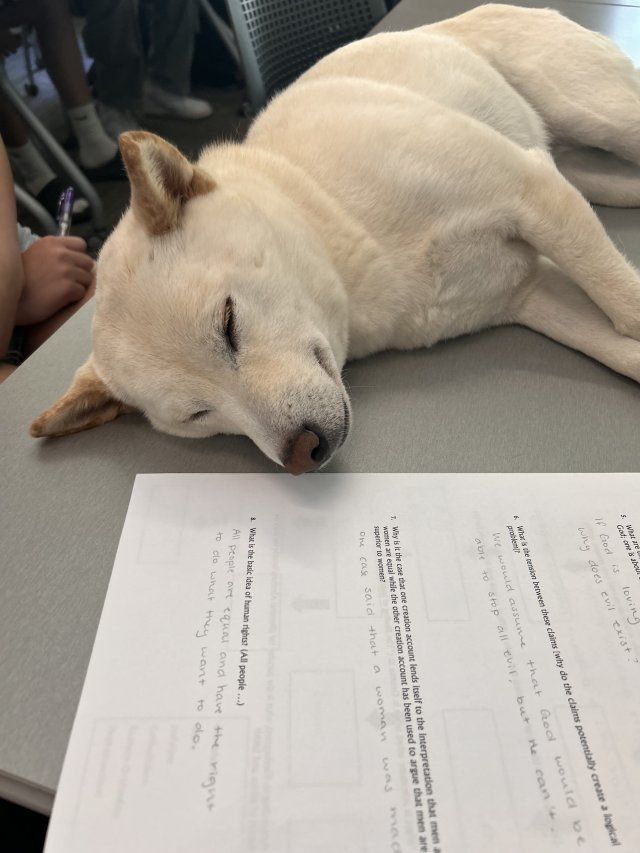
No matter what program you pick, you will develop critical thinking skills, grapple with the most profound questions in life, and be better prepared for any career you choose. Studying with the cutest dogs on this campus doesn’t hurt, either.
For details on the specific program requirements for the Religion or Theology and Christian Leadership majors/minors, please refer to the CLU Course Catalog: https://catalog.callutheran.edu/programs
More
- 2024 Summer Research Cohort Takes On Conferencing!
May 5, 2025All four members of the Religion Department’s Summer Research cohort (Alexia Lye ’25, Daniela Munoz-Martinez ’25, Ken Flores ’26, and Jacqueline Shaw ’25) had their research accepted for the Western Region’s (AAR-WR) annual conference. Alexia’s research discusses Abalone and its importance to the Chumash people. Daniela’s research explores how the Bible was used for and against slavery. Ken’s work explores the rituals of the Shinto Shrine of Shusse Inari in America. Jacqueline’s research examines different interpretations of jihad in medieval Islam.
- Why Study Religion or Theology? And Other Questions About Our Department
November 15, 2024Students often have the same two questions about the Religion Department. “Does the department only teach Christianity?” and “Will professors try to convert me?” The answer to both questions is an emphatic, “No!” The Religion Department—and the CLU as a whole—is committed to the values of Lutheran higher education, emphasizing open-mindedness and inclusion of those from all faith traditions and worldviews.
- 2024 Summer Research Religion Cohort: Four Students Share their Experiences
September 24, 2024The word “research” often evokes images of test tubes, beakers, and brightly-colored liquids in a sterile lab, but research in the humanities can look very different. It can be anything from reading a book (or ten), participating in religious ceremonies, to conducting interviews. This summer, four students, Jackie Shaw ‘25, Alexia Lye ‘25, Daniela Munoz-Martinez ‘25, and Ken Flores ‘26 participated in Cal Lutheran’s 8-week Undergraduate Research Program. Each student received a summer research grant.
- Religion: The Queer Experience
May 3, 2024On March 19 in the Samuelson Chapel Lounge, the Religion Department hosted an event for queer folx at Cal Lutheran to discuss their experiences with religion.
- Longtime Religion Professor, Rev. Dr. Colleen Windham-Hughes, Installed as Associate Vice President of the Office of Mission and Identity
April 26, 2024The Religion Department would like to congratulate Rev. Dr. Colleen Windham-Hughes on her installation as Associate Vice President for the Office of Mission and Identity as of February 22, 2024!
- Religion Department: New Course Offerings for 2024-2025 Academic Year and Beyond
March 31, 2024The Religion Department is excited to announce new courses for the 2024-2025 academic year! These courses fulfill the Humanities requirement of the new general education IDEAS curriculum.
- Nurturing Communities Through Research: Three Religion Students Share Their Passion Projects
December 15, 2023In the world of academia, religion often yields profound insights into the past, present, and future of our societies. It is within this dynamic context that three dedicated religion students, armed with a passion for their respective research interests, embarked on a journey to shed light on fundamental issues in our communities.
- Event Recap: Decolonizing Music: Zitkála-Šá’s Sundance Opera and Religious Resistance
December 5, 2023On November 14 in Overton Hall, the Religion Department in collaboration with the Ethnic and Race Studies Program, hosted a special guest lecture on an Indigenous opera of resistance as part of CLU's program in honor of Indigenous Peoples' Heritage Month.
- Religion Department Welcomes Assistant Professor With Expertise in Indigenous Traditions and Law
November 15, 2023“I'm thrilled to join the faculty at CLU,” Dr. Wilson says. “During my visit last spring, I was impressed by the caliber of students and the university's commitment to service. I'm excited to bring my expertise in Indigenous religions and religious freedom to the department and I look forward to serving as a bridge between CLU and Indigenous communities.”
- Love Knows No Borders: Theology & Christian Leadership Major Speaks at Women of the ELCA Triennial Convention
October 6, 2023